- Navy Service: “The Ghost Watch” (2935–2953)
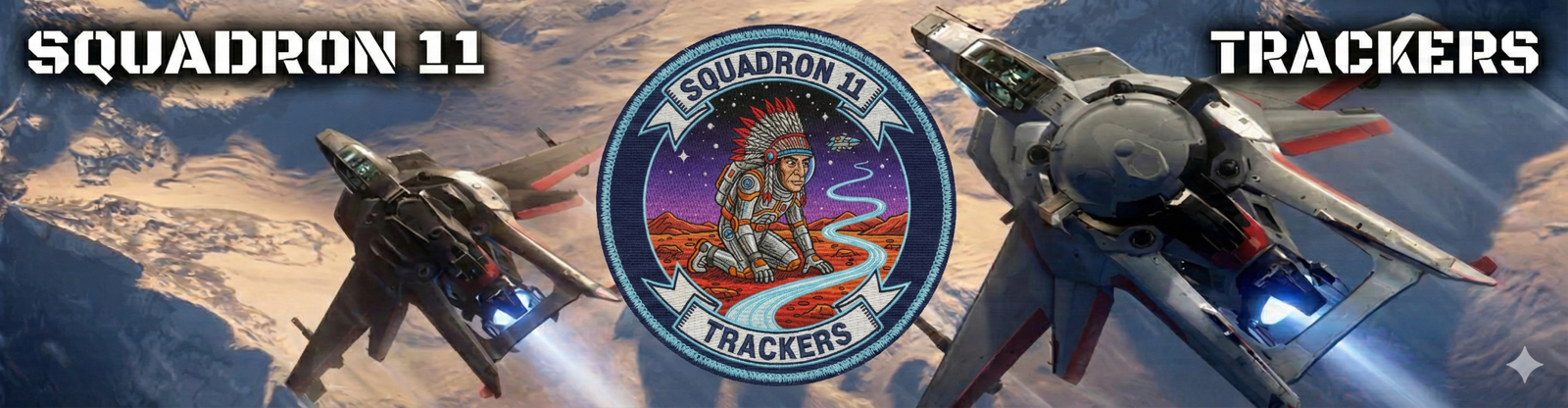
Squadron 11 was never a unit that sought the spotlight. For nearly two decades, they were the “Ghost Watch” of the 5th Fleet, stationed primarily along the Perry Line (the former demilitarized zone between UEE and Xi’an space).
Their job wasn’t to fight; it was to listen. Flying specially modified F7A-R Hornets equipped with the “Long-Look” radar domes, the Trackers spent thousands of hours running silent, passive scans of Xi’an border traffic and smuggling routes.
The “Phantom” Reputation: Because their missions were often classified, Squadron 11 pilots were known for being secretive and detached. They didn’t hang out at the mess hall with the dogfighters. In the fleet, a “Tracker” was considered half-pilot, half-spy—the guy who knew where the enemy was three days before the shooting started.
- The “HuXa Accord” & Deactivation (2953)
The end of Squadron 11 came down to politics and the warming relations with the Xi’an Empire.
In 2953, the UEE Senate ratified the HuXa Trade Accord, a landmark treaty designed to de-escalate tension on the border and open new trade lanes. As a gesture of “good faith” to the Xi’an government, the UEE agreed to reduce its active military surveillance presence in the border sectors by 40%.
- The Sacrifice: Squadron 11, with its long history of “aggressive surveillance” against the Xi’an, was viewed as a diplomatic liability. The Navy didn’t want the Xi’an seeing the “Trackers” on their sensors anymore.
- The Deactivation: The squadron was unceremoniously disbanded in late 2953. Their advanced avionics were stripped, and their hulls were slated to be converted into target drones for fleet practice—an insulting end for a unit that had prevented countless border skirmishes.
III. The Transfer to CSG-3 (2954)
Retired Rear Admiral Glenn “Pappy” Wade understood a fundamental truth of naval warfare: You cannot kill what you cannot find. He knew that while he had the Battlefleet and the air wing, he was blind without long-range sensors.
Wade intercepted the liquidation order before the hulls were scrapped.
- The Acquisition: Utilizing his clearance as a former flag officer, Wade purchased the squadron’s assets under the “Private Sector Security & Search” clause. He argued that CSG-3 needed search-and-rescue assets to assist civilian liners.
- The “Black Box” Deal: The Navy stripped the classified military encryption software, but Wade managed to acquire the physical “WillsOp” radar domes and the Anvil Terrapin command ship that served as the squadron’s mobile HQ.
- Recruitment: The pilots of Squadron 11, angry that their service was sacrificed for a trade deal, were eager to join a commander who valued intel over politics.
- Current Status: December 2955
As of today, Squadron 11 serves as the Intelligence & Early Warning (AWACS) division of Carrier Strike Group 3.
- Operational Doctrine: The Trackers never fly alone. They deploy ahead of the main fleet, drifting silently with engines cut to minimize heat signatures. They act as “spotters” for the Argonaut’s torpedoes, painting targets from extreme range so the main fleet can fire without being detected.
- The Tech: Pappy Wade invested heavily in upgrading their sensor suites. The Trackers now utilize illicit “Wiretap” avionics—systems capable of intercepting pirate comms and triangulation data that standard civilian scanners would miss.