- Navy Service: ” The Can Openers” (2938–2954)
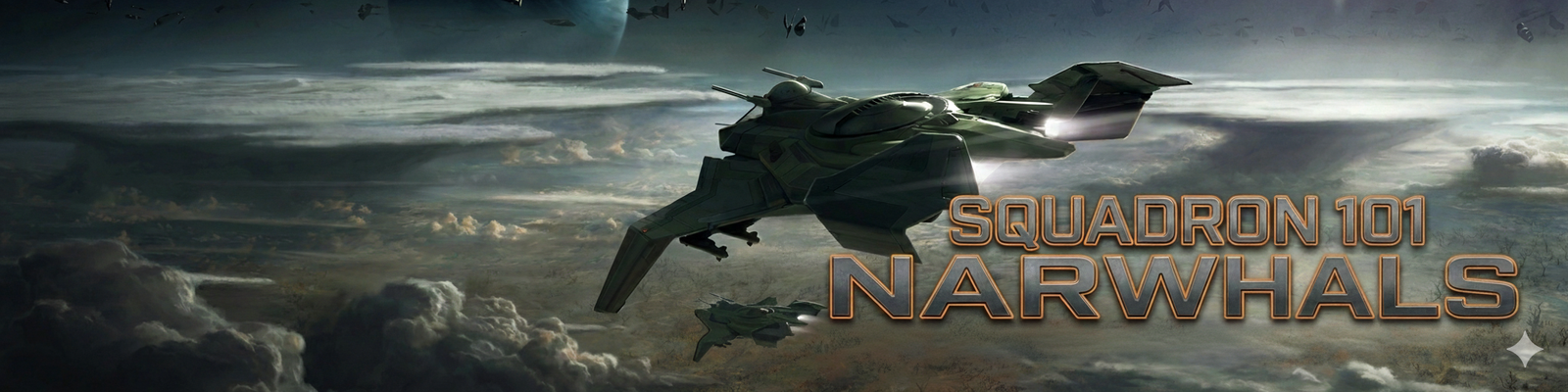
Squadron 101 spent its entire service life stationed aboard the massive Bengal Carrier UEES Indomitable. They were the “working class” of the carrier deck. While the fighter pilots got the glory, the “Narwhals” got the dirty work.
Their specialty was Subsystem Precision Strikes. In large fleet battles, while the capital ships traded broadsides, Squadron 101 would launch in waves. Their job was to dive through the flak screens and deliver Size 5 torpedoes directly into the engines or shield generators of Vanduul destroyers.
The “Narwhal” Maneuver: The squadron earned its name from their signature attack formation: flying in a tight, single-file line (like a spear or tusk) to mask their numbers on radar, before breaking formation at the last second to overwhelm point-defense turrets. They were famously tough; Narwhal pilots often boasted that the Gladiator could fly home with half a wing missing, and they frequently proved it.
- The “Eclipse Protocol” & Deactivation (2954)
The end of Squadron 101 was a casualty of the Navy’s obsession with stealth technology.
In 2954, the Navy began aggressively replacing the older, rugged Anvil Gladiators with the new Aegis Eclipse stealth bombers. The Admiralty argued that a stealth bomber could deliver a payload without taking fire, making the “dive bomber” role obsolete.
- The Objections: The Narwhals argued that stealth ships were too fragile for sustained combat. They famously petitioned the Admiralty: “An Eclipse is great until it’s seen. A Gladiator fights its way out.”
- The Shutdown: The petition was ignored. The UEES Indomitable was refitted with stealth bays, and Squadron 101 was deactivated. Their battle-scarred Gladiators were stripped of military avionics and sent to the desert boneyards of the Ellis system to rust.
III. The Transfer to CSG-3 (Early 2955)
Retired Rear Admiral Glenn “Pappy” Wade had commanded carrier decks in his youth. He knew that in a messy fight, stealth often fails. He wanted a bomber that could take a punch.
- The Rescue: Wade located the squadron’s airframes in the boneyard just days before they were scheduled for scrapping. He bought the entire wing for a bargain price, as the market for “obsolete” dive bombers was non-existent.
- The Refit: Pappy Wade didn’t try to make them high-tech. Instead, he leaned into their ruggedness. The CSG-3 mechanics reinforced the Gladiators’ armor plating even further and tuned the engines for short-range, high-thrust bursts—perfect for carrier takeoffs and combat maneuvering.
- The Call-Up: The squadron’s commander, Lt. Col. Merrick “Harpoon” Daines, was flying cargo when Wade found him. Daines agreed to reform the squadron immediately, happy to be back in a cockpit that “felt like a tank, not a toy.”
- Current Status: December 2955
As of today, Squadron 101 serves as the Carrier-Based Strike Wing of Carrier Strike Group 3.
- Tactical Role:
- The “Anvil”: Because Gladiators are small (unlike the massive Retaliators of SQ 51), they can dock and re-arm rapidly on the Argonaut or Johnston. This allows them to maintain a high operational tempo.
- Anti-Corvette: Their Size 5 torpedoes are perfect for killing medium-sized threats (like Hammerheads, Perseus, or Polaris hulls) that threaten the main fleet.
- Turret Gunners: The Gladiator is a two-seater. The Narwhals take great pride in their back-seat gunners, who protect the bomber’s tail during the dive—something a single-seat Eclipse can’t do.