- Navy Service: “The City Levelers” (2940–2954)
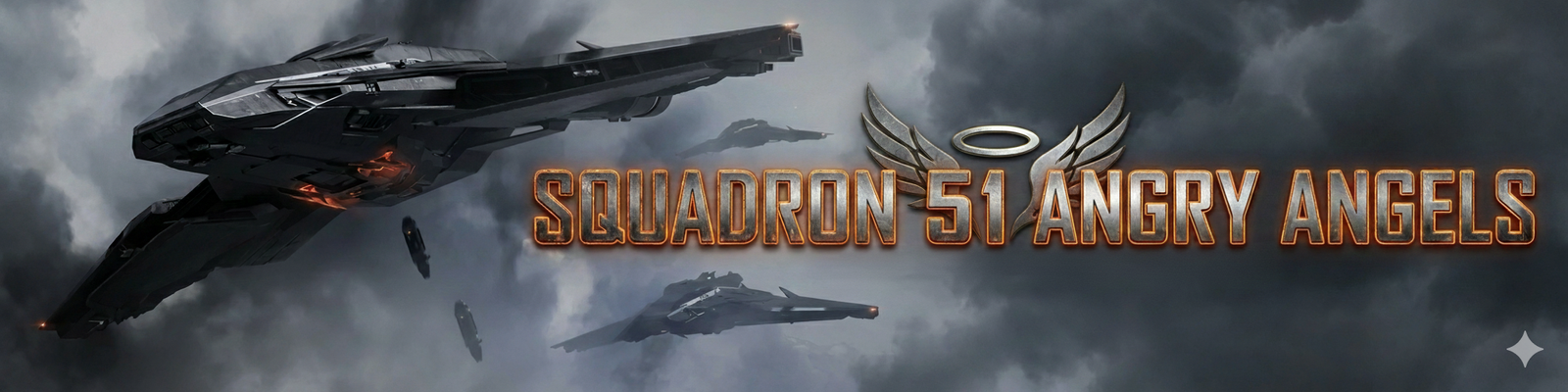
Squadron 51 was not a tactical unit; they were a strategic one. While other squadrons fought fighters, the Angry Angels were tasked with breaking entire enemy infrastructures.
Operating the Aegis Retaliator, they were the Navy’s “Long Sword,” capable of delivering massive Size 9 torpedo payloads deep behind enemy lines. In 2950, during the Vanduul pushes, the squadron was authorized to field test the Crusader Hercules A2, a massive “flying fortress” capable of dropping the terrifying Colossus bomb.
The “Doomsday” Reputation: The squadron became infamous for the “Siege of Tamsa,” where a single A2 flight from Squadron 51 leveled a pirate fortress that had withstood ground assaults for months. They were effective, but their methods were viewed as “excessive” by the increasingly image-conscious UEE Senate.
- The “Efficiency Reform” & Deactivation (2954)
The deactivation of Squadron 51 was a result of two factors: Manpower and Politics.
- The Manpower Crisis: The Aegis Retaliator requires a crew of 4-6 people to be effective (pilot + gunners + engineers). The Navy realized they could field six single-seat Aegis Eclipse stealth bombers for the personnel cost of one Retaliator. The “Angels” were deemed a waste of human resources.
- The PR Nightmare: The Hercules A2 is a weapon of mass destruction. After a mission where an A2 bomb caused significant collateral damage to a civilian mining complex held by insurgents, the Senate pressured the Navy to retire these “indiscriminate” weapons from standard patrol fleets.
In late 2954, the order came down: The Retaliators were mothballed in favor of the Eclipse, and the A2s were stripped of their military bomb bays and sold as standard transports. Squadron 51 was disbanded.
III. The Transfer to CSG-3 (Early 2955)
Retired Rear Admiral Glenn “Pappy” Wade saw the deactivation not as a tragedy, but as a shopping list. He knew that when fighting the Vanduul or heavily armed syndicates, “stealth” and “precision” aren’t always enough. Sometimes, you just need to erase the grid square.
- The Retaliator Acquisition: Wade bought the squadron’s Retaliator hulls from the surplus yard. He argued that their modularity made them “multi-role cargo ships” on paper, while secretly restoring their torpedo bays.
- The Hercules A2 Heist: The A2s were harder to get. Wade found two hulls that had been gutted and slated for conversion into M2 cargo haulers. He purchased them and used his connections at Crusader Industries to “lose” a shipment of military-grade S10 bomb chutes, which mysteriously found their way back onto the ships.
- The Crew: The multi-crew nature of these ships meant Wade had to hire a lot of people. He recruited the original Squadron 51 crews—tight-knit families who had served together on the same ship for years and refused to be split up by the Navy.
- Current Status: December 2955
As of today, Squadron 51 serves as the Strategic Strike Arm of Carrier Strike Group 3.
- Tactical Role:
- The “Anvil” (Retaliators): The main body of the squadron flies Retaliators. They serve as “torpedo trucks,” launching massive volleys of Size 9 torpedoes at capital ships from distance, saturating point defenses so the Johnston can close in.
- The “Hammer” (Hercules A2s): The squadron operates two A2s, named Thunderchild and Brimstone. These are used for planetary assaults or clearing massive debris fields. When an A2 enters the atmosphere, ground forces surrender.
- Defensive Capability: Unlike standard bombers, the Retaliators and A2s are covered in turrets. They fly in a tight “box formation,” creating a overlapping wall of turret fire that shreds any enemy fighter foolish enough to get close.
- Signature Tactic: The “Angel’s Chorus.” The Retaliators launch torpedoes to force the enemy to shield-brace, and in the confusion, the A2 drops a MOAB (Massive Ordnance Air Blast) directly into the enemy formation’s blind spot.